Monday, July 28, 2008

Hurricane Dolly In Nebraska?

Yes, that's true. What's left of hurricane Dolly, which ripped through Texas and Northern Mexico, did a sharp right turn and headed north. Now downgraded to heavy thunderstorm status, its remnants have taken dead aim at Alma and will pass through here in the next twelve hours or so. I intend to be sound asleep, but with the windows open for the cool night air, it might wake me up, who knows.

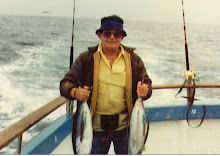
This is my neighbor, Steve, who is usually my fishing partner, with a couple of largemouth bass he caught at the lake. Unfortunately, I didn't get any keepers that morning. Minimum size limit here is 15 inches for largemouth and 18 inches for walleye.

It is said that in the world of fishing, 10% of the fishermen catch 80% of the fish. Steve is in the 10%. I am not. Most people around here agree that he is the most knowledgeable shore fisherman in town. Since I don't have access to a boat (rental is $150.00 per day), learning where and how to fish from the lake shore is what I need, so I generally fish with Steve. My specialty seems to be centered on catching fish one half inch shorter than the limit.

Ah, well. Since I support the belief that every moment spent fishing adds an equal amount of time to the length of a person's life, I am not discouraged by my inability to drag in keepers like Steve does.
This, of course is the walkway where my daughter and I go walking next to the lake. That tree limb bridging the path doesn't belong there. It is the unfortunate victim of some really high winds that came roaring through here a couple of weeks ago. The city was inclined to simply leave it as is until a second windstorm zeroed in on Alma.

Yep, down came the limb even lower. When my daughter, Eva (who is 5' 1"), can't walk under it, it's too low. The next day the limb was gone and the trail was back to normal.

This is one of the little meadows along the trail. Notice how the lowest tree branches on the trees in the background all seem to be the same height from the ground? That's courtesy of the local deer population which keeps it trimmed as high as deer can reach as they feed off the new and tender green growth. Maybe we should look at the deer as mother nature's gardeners.

After a lifetime in Southern California where everything turns brown in the summer, the green here can seem overly intense. Even in so-called drought years, there is enough summer rain here to keep things bright green. It's a big, big change. When I explain to the local people that when the end of May rolls around in L.A., there will be no rain until late November or early December, they seem at a loss to fully digest that piece of information.

Eva is quite proud of the fence surrounding the vegetable garden at her house, which she and her fella put up to keep the deer out. Unfortunately, one night the determined deer knocked one side of the fence down and feasted on the tender new growth. An angry Eva, who is not a hunter, nonetheless said, "I don't care how many kiddies love him. If I catch Bambi, I'm serving him for dinner."

Such is life on the prairie.

Wednesday, July 9, 2008

Family Royalty?

It seems our extended family has expanded in the person of one puppy. Last Friday, while enjoying the festivities in the park after the Fourth of July Parade, my oldest, Eva Marie, saw a town resident sitting under a tree keeping watch over a large, topless cardboard box. As we walked by, Eva spotted a writhing mass of black furred puppies within the box, so, of course, she reached in picked one up. It was a fait accompli. There was no way a woman who loves animals the way she does was going to put that young canine back in the box and walk away. Asking her to think twice before taking it would be like asking a Saudi Sheik to consider not selling oil.

This is the culprit. According to the guy with the box, the mother is a Greyhound and the father is a "traveling man", but most probably a horny black Labrador Retriever that roams the local neighborhoods. My daughter and my 16 year old granddaughter have agreed that his name shall be "Prince Dude". We can guess as to which of the two girls came up that name. So far, I think his handle ought to be "Sir Piddlesalot".

It's hard to see any Greyhound in Prince Dude, and my suspicion so far is that this character's temperament will prove to all black Lab, which means my daughter's household is in for a wild ride.
Of course, not all members of my daughter's household are thrilled by Prince Dude's arrival. This is Abbie, who has pretty much ruled the house for several years. Cats, generally, allow people to feed and house them, and will often react with utter disdain toward unapproved changes in living conditions. So far she has not attacked "The Dudester", but she has shown off her most dramatic hiss when the puppy's curiosity has brought him too close. I think that, in time, the two will learn to get along. It's been my observation that once a cat and a dog hammer out a working relationship, it will be hard for the dog to stretch out and sleep without the cat deciding it needs the dog's body warmth for its own nap.

Many years ago, the family acquired a snow white Samoyed, appropriately named "Sam", whose biggest problem in life seemed to be that the standard twenty-four hour day did not offer enough time to get in all the naps that he needed. His response was to leave great lumps of white hair on the carpet when the nap ended and he walked elsewhere to take another nap. Now, we had a Siamese cat at the time, who for three days after Sam's arrival, refused to let her feet touch the floor. She traveled by jumping from one piece of furniture to another when Sam was around. But within a few weeks, it was a common sight to see Sam snoring on the living room floor and the cat curled up literally in the armpits of his two front legs getting all the body warmth possible for a serious feline snooze.

There is an animal that Eva is not sure she loves, and that is the deer. Every summer Eva keeps quite a garden in her backyard and canning its output is the reason for its existence. She was a little tardy in getting her fence put up around the garden this year and the deer came in at night and feasted on her cucumbers and a couple of other newly sprouted vegetables. It's too late in the season to re-plant the cucumbers from seed, so she's looking for starter plants at some of the local sources. These were pickling cucumbers, not the type you use for salads, but the type you turn into dill pickles or bread and butter pickles. The deer also got to one of the horseradish plants, but we're hoping enough of its greenery is left for it to bounce back. The row of broccoli was a total loss, though, and they had a pretty good time with some of the lettuce. I guess deer can be picky eaters because they absolutely ignored the carrots.

For the many, many people in rural areas who plant such gardens, deer, rabbits, moles and similar critters are an ongoing frustration.

Tuesday, July 8, 2008

It's The Library's fault.

Darn, I let this blog go a long time again without a post. It's not my fault, really. If the Alma Public Library wasn't so darned good, I would have all the time in the world for updating the blog. I've been doing a lot of fishing lately (and a lot of catching), and when I get home I am really tired, too tired to be creative with the blog. So, I grab one of my books from the library and read for awhile. Being a good obsessive compulsive person, once I start a book, nothing else in the world exists until it's finished. Once I've finished the book, it's time to go fishing again, and when I get home I am really tired, and the circle keeps going. So you can see that if the library didn't supply every book I want, I would be posting a lot more regularly. You certainly didn't expect me to take responsibility for the results of my own procrastinations did you?

The Alma Library really is remarkable. It has a terrific stock of the most popular mystery writers, and every Thursday, UPS delivers the latest new books for its shelves. I am a freak for books by Janet Evanovich, and her latest book in the Stephanie Plum series, "Fearless Fourteen" was delivered to the library on June 17. To my horror, I discovered I was number three on the list of Alma citizens waiting for its arrival. Reader number two turned the book in yesterday and I took possession (for a maximum of two weeks) today. Evanovich books are fast reads, so I'll probably finish it and turn it back to the library tomorrow, after I go fishing in the early morning. Do you detect a vicious cycle here?

The library (actually the Hoesch Memorial Library) doesn't carry much in the way of science fiction, and I am a lifelong sci-fi fan. I'm talking hard core science fiction here, not the "Sword and Sorcery" stuff that seems to be rage these days or some of the silly mutation creature flicks turned out by the sci-fi channel. However, the state of Nebraska has an inter-library loan system that is so efficient that it took me awhile to get used to it. I can come up with some pretty arcane sci-fi books that you think would be hard to find, but every time I hand in a request, giving them the author and title, the book is ready for me to pick up within 48 hours. The library charges 1.50 per book for the service, and it is cheap at many times that price. Going on-line I regularly prowl the selections available at the biggest sci-fi publishers (Baen Books, Tor and others) and have yet to find one they couldn't come up with. At the Baen website, I ran across an author I was not familiar with, Margaret Ball, whose latest sci-fi work was "Disappearing Act". The short synopsis on the website made it sound interesting, so I put in the request, and sure enough, 48 hours later I got the telephone call that the book was in Alma and waiting for me. And it turned out to be a very good story, so I'll look for more of her work. And so it goes.

The turnout for the Fourth Of July celebration in Alma was stupendous. With Harlan Lake being 108% of capacity, with a downtown parade in Alma followed by food concessions and arts and crafts displays in the park, with a huge fireworks display over the lake in the evening, with the new Super 8 Motel now open and running, and with many people looking to beat the high cost of travel by staying as local as possible, this place was jumping. Remember, Harlan County Lake is no small pond. It currently is approximately ten miles long and about a mile and a half to two miles wide. It has three major harbors and several smaller boat launch areas. Fishing boats and jet skis were everywhere. I believe the fishing people were ready to exterminate the jet skiers, who often showed an incredible lack of consideration of the rights of others, but mostly a good time was had by all.

The people who run the lake, the Army Corps Of Engineers, estimated the numbers of visitors to the lake this weekend at more than 52,000 people. Holey Moley, Captain Marvel, that's a lot of people to show up in a town with a permanent population of 1,242. The stores, including our only supermarket, were mostly crowded. Yes, they were all open on the holiday, anxious to let those visitors come in and leave some of their money in Alma. All the eating places were jammed all weekend, but Friday the Fourth was a nightmare if you wanted to sit down and buy a meal. Wow, what a crowd.

I was able to beat the crowds Friday night for the big fireworks show. At the corner just outside my front door, I set up my folding chair and I had an unobstructed view of the display. My apartment is less that one fourth of a mile from the lakeshore, so it was like being right there at the launch point. I watched the rocket trail as it lifted skyward, then oohed and aahhed at the brilliant showers of color and sound. All the festivites and the crowds made it a perfect way to celebrate our nation's birth.

Tomorrow, I'll tell you about our newest family member, "Prince Dude".

Tuesday, April 22, 2008

Why All The Water?

I watched a TV news item on how the levels of Lake Meade and Lake Powell, both on the Colorado River, are at dangerously low levels due to an eight year drought. If it gets any lower on Powell, it may not be able to run the turbines that produce so much power for the western states. The largest lake in Nebraska, Lake Mconaughy on the North Platte River near Ogallala, suffers the same condition. The areas where it originates in Wyoming have seen considerably less rain than normal and the lake is only 40% full. It's a sad situation.

Harlan County Lake in Alma, Nebraska, though, is higher than it has been in more than twenty years. It is filled by the Republican River, which flows (naturally) through Republican Valley and meets the dam built in 1954 by the Army Corps of Engineers at Republican City (population 199).

I took this picture while fishing on the river yesterday (no fish, no joy). The Republican River is certainly not the Colorado, but it is a nice local waterway. It is as narrow as 20 feet and as wide as 200 feet, and at its deepest is probably 6-8 feet. It is carrying more water right now than most locals have seen in many, many years. One fella was telling me that less than five years ago during the summer, the river was dry - Not a drop of water in it.

Why we have all the water is not clear to me yet, but between last year and this year additional rain on the river course has taken Harlan County Lake to dramatically higher levels. It's a delight to the local businesses because the word is out and we can expect lots of tourist money to be spent in the area this coming summer. While other lakes are shrinking, Harlan County Lake is growing in size. Currently the lake is about nine miles long and at its widest point is about two miles wide. It's a big lake.

If you have Google Earth on your computer, ask it to take you to Alma, Nebraska. You will see the lake and your first reaction may not be positive. That is because the pictures of the lake have not been updated in four to five years. What you will see is how low the lake was at that time. It was low, really low. If you look at the picture on Google Earth, you can see a road on the left that leaves Alma and crosses the river. That road is highway 183 and it's really a long bridge over the the river and over a large dry area where the lake used to be. Today, the lake is back and extends well to the left of the bridge.

That part of the lake is now a large, shallow estuary and has attracted some wildlife I did not expect to see here. How in the world did pelicans find their way to Nebraska? How did all the seagulls get here? They are here in significant numbers, so it's not just a wayward bird or so that got lost. I want to fish that estuary area because it looks like prime territory for catfish and largemouth bass, but it takes a boat to get there and I have yet to acquire one.

The gulls and pelicans give the boat fishermen a road map to where the fish are. Out on the deepest pars of the lake, large schools of baitfish (shad) are continually on the move. The birds follow the schools and grab what they can near the surface. That tips off the boats filled with anglers to head that way. Where the bait fish are, so are the bass, walleye, wipers, white bass and other fish.

What it boils down to is that whatever Mother Nature is doing to the Republican River is fine with me and most of the other people in the area. It will probably also help our relations with Kansas which continually files lawsuits demanding we quit using so much water from the river. Just as California, Arizona and Nevada fight over water rights to the Colorado River, so do Nebraska and Kansas wage litigation war over the Republican. Ah, Well.

Sunday, April 20, 2008

Computer Crash.

When I crash a computer, I don't mess around. I am finally up and running again after a week of no joy. For any tech types reading this, I finally gave up trying to fix the computer. I re-partitioned, re-formatted and re-installed everything. I thank my stars that I have learned to back-up my computer at the end of every month. It could have been worse, but it was still a monumental pain in the @*$!. Ultimately, all went well, except during the process of reloading programs I ran into some "slight" problems and wound up cursing Microsoft in general and Bill Gates in particular and finally subscribed them both to several interesting new hells of my own creation.

In Alma, Nebraska, of course, spring has sprung. From snow flurries at the first of the month, we are now seeing greenery everywhere. Fishing is good, walking is good, life is good, and today it is eighty degrees.

I saw a big difference last night between rural Nebraska and Los Angeles. Alma High School had its annual junior/senior prom. My granddaughter, a junior, dropped by in her gown and brought her date along, a young man named Adam. Since facilities are limited, a formal dinner was held at the auditorium downtown and the dance was held in the Alma High School gymnasium later. Lots of adults gather downtown to see what kind of vehicles bring the kids to the dinner. Now, in California, we all know that the kids rent limos these days. There was just one stretch limo here, an SUV that seemed to have fifty kids in it (probably only about twelve), but aside from that the methods of arrival could only have happened in a farming community. How about big John Deere tractors cleaned and polished beyond belief, with even the tires gleaming a glossy black. I liked the big, big crew cab pickup truck that must have been polished for three days to get that kind of a gleam and the tractor cab from an eighteen wheeler that could only have been cleaned and polished by a team of workers. I think I saw everything except a riding lawn mower used to transport the various and gorgeous young ladies to the dinner. I hope the kids remember it as a special evening.

To satisfy my never ending curiosity, I attended an auction at the cattle sale barn last Tuesday. It was, indeed, an education. The local ranchers bring cattle to the sale barn in Alma once a week and every Tuesday, they are auctioned off. Most of the animals for sale were cows, as opposed to bulls, and were brought individually into an indoor pen about thirty feet square with entrance and exit gates controlled by two men. I immediately noticed that on every side of the pen was a protective barrier like we see in bull-fighting rings for the matadors to seek safety behind. I soon found out why. The cows were brought in one at a time and the auctioneer began his rapid fire routine. As each animal enters the pen, it steps on a part of the floor that is really a scale covered with dirt. The weight then pops up on a large LED display for all to see. The lowest I saw was about 900 pounds and heaviest was just over 1700. Sale prices ran from slightly less than fifty dollars per hundred weight to almost seventy dollars.

Many, many of the cows were really hard to handle and entered the pen with one object in mind: To hurt someone, anyone, as soon as they could. The two men in the pen were well experienced and didn't hesitate to get behind the safety barriers when circumstances looked dangerous. It was explained to me later that the bad attitude of those cows was exactly why they were up for sale to the feed lots: The ranchers don't particularly want dangerous cows in their pastures. It's no fun, they say to drive out to the far reaches of the ranch to repair a fence or check out a calf born the night before and wind up running for your life as you try to work. The cattle brought to the sale barn normally go straight to the feed lots to fatten up and soon after appear as the Thursday beef special at your local market.

Nebraska, of course, is known for its corn production, but cattle ranching is a huge business in this state. It is not rare to go to lunch at a local eatery (Bugbee's in Alma, for instance) and watch some ranch workers walk in wearing beat up stetson hats, cowboy boots and spurs. A lot of them work all day on horseback, and taking off the spurs is just too much hassle when they go to lunch. My oldest daughter is dating a fella who owns a small ranch (fifty head of cattle normally) and is a member of the local cattlemen's association. They had their annual dinner a week ago at "The Station", a local upscale restaurant and bar, and she said she has never been served a steak that big in her life. She also says she ate it - all of it. I think it's state policy to deport all vegetarians to other parts of the country. Beef is where its at in Nebraska.

A source of concern for cattle ranchers is the "globalization" of the meat packing plants. Swift and Co., a grand old name in meat packing, was purchased last year by a company from Brazil. That company is now looking at buying the next two largest meat packers in the U.S., which has all kinds of negative implications for the small ranchers. They fear the "chickenization" of the beef industry. Just as chickens are now produced primarily under direct contract to the meat processors for various fast food franchises, some can see that before long most ranches might produce their cattle on contracts from packing plants, and the thought does not set well with them. Only time will tell.

Tuesday, April 1, 2008

All I can say is , "Wow"!

Some friends took me to the Rowe Wildlife Sanctuary on the Platte River to see the Sandhill Cranes. I was literally astonished at what I saw.

First off, my friends' daughter, Keanna, is an employee of the sanctuary and often appears on local TV to promote the work there. She, of course, gave us the guided tour and even arranged to have us participate in a catered dinner with the staff.

We were there for the evening "show" when the cranes return to the Platte to rest for the night after having spent the day foraging in the fields for food. These cranes are heading north to Canada, Alaska and Siberia to nest and raise the next crop of young Sandhills (For whatever reason, newly hatched cranes are called "colts"). They stop at the Platte for about a month to "refuel" and gain strength for the rest of their journey, increasing their body weight by about 18%, according to Keanna. It is the sheer numbers of these cranes, though, that absolutely boggled my mind.


On a fifty mile stretch of the Platte there are currently 400,000 Sandhill Cranes. We were told that is approximately 80% of all the cranes in the world. They leave the Platte at daylight each day to forage in the fields and return at dusk to the safety of the river. During the day, the cranes search the fields for leftover corn from the harvest. I have read that they are doing the farmers a favor by eating that corn: If left to sprout, the seeds produce inferior and unwanted corn. The cranes also pick through the available "cow pies" looking for undigested goodies. That's not my idea of a great meal, but if it works for the cranes, so be it.

Using 50X binoculars in the fading light, I was looking down the river at an area about the size of four or five football fields packed with cranes. I asked Keanna how many she thought were in that area and she said, "Oh, about 40,000". We are not talking little canaries or sparrows here, folks, these are pretty big birds. They stand almost three feet tall and weigh about 9 pounds on the average. Holey Moley (As Captain Marvel used to say), that's a lot of big birds in one small area.

They are easily spooked, and for those in the prepared "blinds", no flash photography is permitted. Noise is kept to a minimum. Keanna told us she regularly relieves people in the blinds of cellophane packages of munchies. The noise of opening the package will send the cranes flying. In the photo above, something has frightened the birds and they are taking to the safety of the skies.

The prohibition of flash photography means that pictures will normally be taken with 35mm film rated at 800 ASA or higher. Except for costly high end products, most digital cameras cannot compensate for the low light of dusk and dawn when the cranes are most at rest. using 800 ASA film out here means a trip to Kearney (60 miles) to a professional camera store, as you won't normally find it at Wal-Mart or Target.

With its shallow waters and hundreds of islets, the Platte is an ideal haven for waterfowl. Predators, particularly coyotes, find it very difficult to sneak up on them when wading through water is involved. Wile E. Coyote would get no meals here, even with the help of products from the Acme people.

Counting cranes, geese, ducks and all other types of migrating waterfowl, authorities estimate that 14 to 16 million birds pass through the migration skyway in mid-America each year. For more than a month I could see flocks overhead every day winging their way north. In the fall, I expect I'll see them heading south.

The Sandhills Cranes generally winter in southern New Mexico and southwestern Texas in marshes and estuaries. Life is not necessarily secure there, however, as those states allow hunters to take the cranes as allowable game. Nebraska is the only state in the union that forbids the hunting of cranes, and that is remarkable considering that this is a big, big hunting state, so much so that some people claim that the opening of deer season should be a religious holiday.

I intend to be at the sanctuary each spring and fall for this spectacular show of mother nature at work. In the spring the month is March. Keanna told us that by mid April all the cranes will be gone and the Platte River will lazily wind its way toward the Missouri without the companionship of nearly half a million spectacular birds.

What a sight. What a place this is.

Sunday, March 23, 2008

Odds and Ends

Today is March 23, Easter Sunday, and it is also my oldest daughter's birthday. She says she is 29. Yeah. Right. I asked her how she explained that to her oldest daughter who lives in Sacramento and is 30 years old herself. She just smirked and turned her head away. Since I am her daddy, I know exactly how old she is, but I'm not going to print it here. We're all having Easter dinner at her house tonight.

The weather just keeps getting better but is still inconsistent. Old man Winter simply wants to hang around as long as he can. Today it's going to be about 55 degrees, then dip down into the twenties tonight and then go up close to 75 tomorrow afternoon. to take advantage of that warmth, I'm going fishing in the Republican River with my friend Steve tomorrow. The walleyes, white and largemouth bass, and some others have moved out of the lake and into the river to spawn. We're going to see if we can relieve the fish congestion in the river and add to the congestion in our freezers. I went fishing at Cedar Point on the lake two days ago and caught a 3 to 4 pound carp, which I sent back to its momma. The lake is still a bit too cold for most of the true game fish to move into the shallows.

My daughter, Eva, and I will start walking the trail by the lake again tomorrow morning. During the winter the auditorium downtown is open for those of who like to walk in the morning and Friday was the last day until next winter. I can only describe it as "round and round we go". Circling the inside of the auditorium 26 times equals one mile of walking. Fella here named Don opens up and brings his boom box with a great blend of CDs to keep us from getting too bored. Most of us who walk are senior citizens trying to stay healthy. Eva, having been born in 1957, has no liking for Glenn Miller and Benny Goodman, but Don does play a set of their music, which suits me just fine. One of the walking couples in their mid to late seventies will occasionally forgo the walking and swing into a dance in the middle of the auditorium when a piece of music really takes them back. I'm not talking gentle waltzing here. I'm talking lively dancing that gets awfully close to the old jitterbug stuff of WWII. Friday they bounced out there when Bill Haley and the Comets started in on "Rock Around The Clock". I do not foresee "rockin' chairs" in the near future for them.


The top picture is a photo I took last summer of one of the clearings along the lake walkway.
At the bottom is what that same general area looks like today. Summer is prettier without a doubt and the process of changing into summer is well along the way. Many of the trees limbs have the little growth nubs that will become leaf and branch with time. Here and there little of spots of green grass are pushing their way into the light. I will be able to watch the change of the season on a daily basis. It's a new experience for this old Angeleno and it's fascinating.

Oh, and by the way, in the state finals for the high school speech teams, my granddaughter's team took fifth place. Not bad for a school with a grade 7 to 12 population of approximately 250 competing against schools from Omaha and Lincoln with populations of 1500 and up. They did a good job.

The migrations of geese and duck are just about finished. For most of this month anybody looking skyward would have seen multiple vee shaped formations of waterfowl heading north. Often the sky was filled with thousands, perhaps tens of thousands, of geese and ducks. I have never before in my life seen such a thing and I don't mind telling you that it was spectacular. They call this area part of the "flyway", and I can certainly see why. I thought I could appreciate the few such formations I would occasionally see in California, but the sights here are often flabbergasting. It makes me appreciative of the need to preserve our wetlands so that these migratory populations will always be able to find a temporary haven. I like to think of myself as a pragmatic conservationist, and by that I mean that while I am an environmentalist, I also think hunting organizations like Ducks Unlimited deserve tons of praise for their efforts to promote wetland preservation. They recognized long ago that without places for the ducks and geese to exist, they would have nothing to hunt. Everybody has benefited. I have no selfish interest in saying good things about a hunting organization. I don't own a firearm of any kind and haven't in over forty years, but plain old practicality tells me people with what may appear to be conflicting interests can find common ground that is helpful to all.